


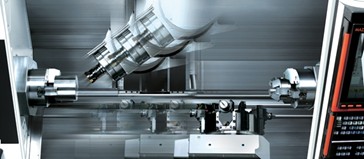
Innovation, technologies, and the principles of Industry 4.0 are pushing the metalworking industry to the next level. MEGA Tech h explores key advancement that transforms the metal cutting processes, allowing manufacturers to perform smarter, more efficiently, and in a sustainable manner.
Automation is Essential for Modern Manufacturing
Automation transforms metalworking by boosting efficiency, precision, and safety, making the industry more competitive and agile. Systems like conveyors, automated guided vehicles (AGVs), and bulk-feeding solutions ensure a continuous flow of materials and work-in-progress between processing stages, reducing bottlenecks and downtime. Cobots are used in loading and unloading heavy or hot parts from machines, which relieves employees from strenuous or dangerous tasks. A wide range of robots are also widely used in the secondary processes, such as welding and cutting. Besides, tasks like polishing and deburring can be carried out by 6-axis articulated robots utilizing sensors, vision systems, and end-effectors for precision material removal to ensure uniform surface quality.
In todayʼs market, key players have offered various automation systems. Hurco offers in-house automation solutions, primarily through their ProCobots division and a collaboration with Kawasaki Robotics. Key innovation includes the Automation Job Manager, a control feature that eliminates the need to program robots separately. Mazakʼs Automation offers integration of cobots (like the Ez LOADER) and pallet systems (like PALLETECH) for lights-out, efficient production
Fast Improvement in CNC Controllers
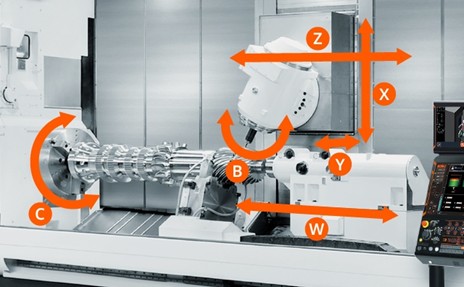
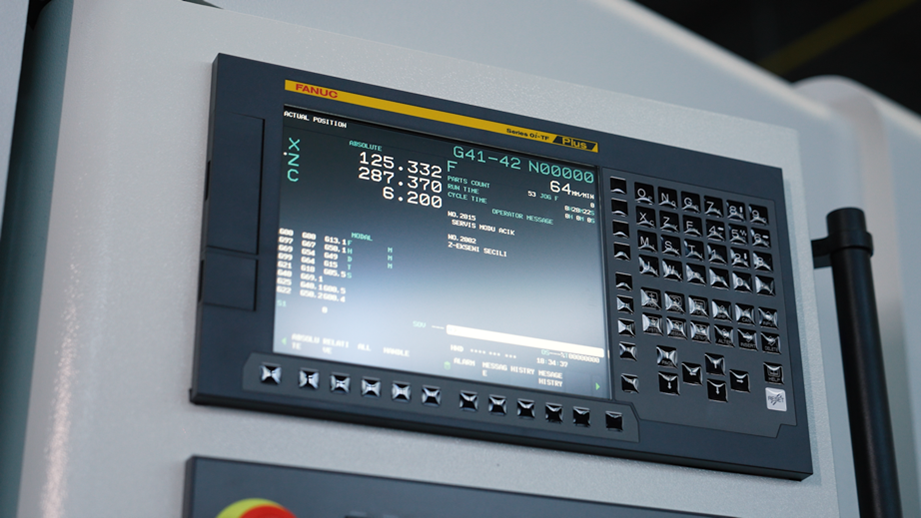
The controller of the CNC machines acts as the “brain” of the entire operation. The controller reads and decodes the programme (G-code or M-code), then sends precisely timed electrical signals to the motor drives, commanding the movement of each axis (X, Y, Z, and any rotational axes) in perfect synchronization. The controller provides the Human-Machine Interface (HMI), which allows operators to input programs, monitor performance, and make real-time adjustments, enhancing usability and reducing human error.
Recent enhancements include Mazakʼs Mazatrol DX, the new control platform with Quick Mazatrol programming for faster setups and streamlined digital workflows. The Mazatrol DX comes with the ability to import 3D solid models (.stp files) directly into the control for “click-and-cut” conversational programming, which automatically generates necessary transform planes for 5-sided machining.
As AI is everywhere, Hurco is leveraging machine learning to introduce features like AI Feature Recognition, which drastically reduces programming times by automatically iden-tifying and programming part features. It also offer ChatCNC™, an AI-powered chatbot for instant operator support.อ
More Tasks, More Profits
The concept of multitasking comprises of multiple machining processes, such as turning, milling, drilling, and grinding, into a single CNC machine. This is achieved through sophisticated machine configurations, such as turn-mill centers (combining lathe and milling functions), multiple spindles, automatic tool changers (ATC), and additional axes of movement (like 5-axis or B-axis capabilities).
Multitasking offers significant advantages in modern manufacturing. It eliminates the time wasted in moving parts between different machines and re-setting up the workpiece, dramatically reducing overall cycle time. This concept enables fewer machines to complete a part, saving valuable factory floor space and reducing the need for constant operator handling and supervision. Multitasking machines can handle a wide variety of part geometries and are well-suited for high-mix, low-volume production environments.
Leading brands offers multitasking CNC machines such as DMG MORI offers a wide range of versatile multitasking centers, including machines for ultrasonic, laser, and additive manufacturing alongside traditional milling and turning. They emphasize automation and Industry 4.0 integration with their CELOS control system. Okuma offers a dedicated line of multitasking machines in their MULTUS series. Other notable names include DN Solutions (formerly Doosan Machine Tools, Makino, and Haas Automation.
Hybrid Manufacturing
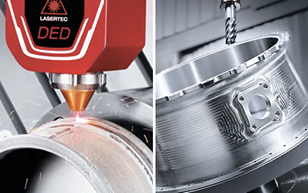
Hybrid manufacturing combines the design freedom of additive manufacturing (AM) with the accuracy of subtractive manufacturing (SM) in one system. The hybrid additive/subtractive manufacturing integrates 3D printing and CNC machining, allowing for complex, hard-to-build parts with high precision and superior surface finishes, overcoming limitations of each method by building near-net-shape parts with 3D printing then precisely finishing features with machining, all on a single machine or production line. This synergistic approach enables difficult-to-make geometries, multi-material parts, and reduces production time.
Major machine manufacturers offering hybrid manufacturing solutions for various industries. DMG Mori offers the LASERTEC DED hybrid series, which combines 5-axis, fibre laser metal deposition with a full 5-axis milling machine in one unit. Yamazaki Mazak provides hybrid systems like the INTEGREX i-400 AM, which integrates a DED (Direct Energy Deposition) nozzle onto a multi-tasking CNC machine. Siemens, while not a hardware producer of the machines, Siemens is a key player at the software level, providing its Siemens NX software for hybrid additive and subtractive programming, which is used across various manufacturers’ machines.
Summary
The business must consider integrating these advanced technologies into its core operations and production processes. It addresses major industry challenges like labor shortages, boost productivity, reduce downtime, and the need for consistent, high-quality output. It isnʼt just the future-itʼs the solution to staying competitive in todayʼs fast-paced market.
Article by: MEGA Tech