



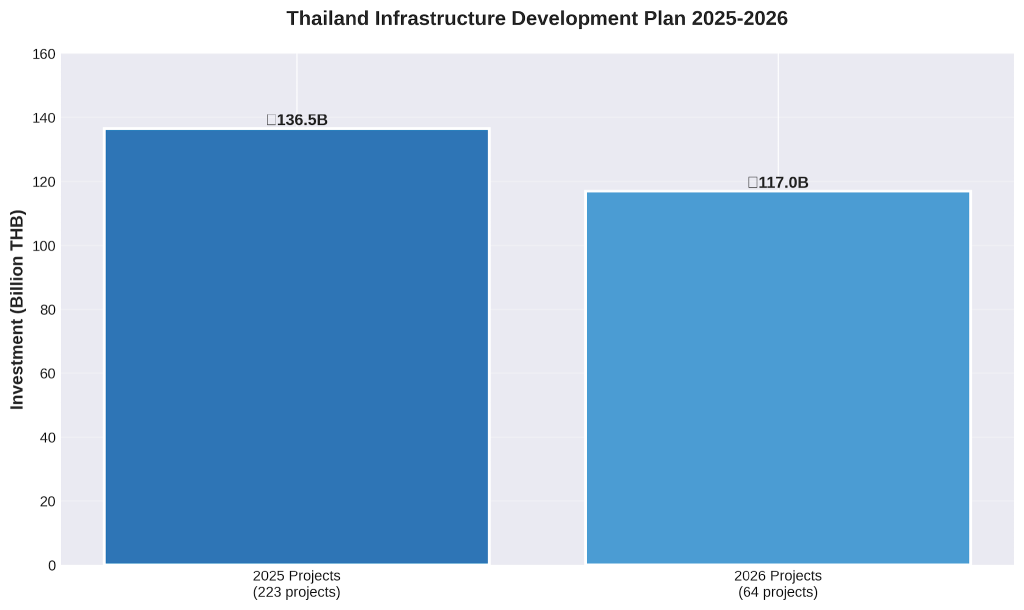
Thailand is currently in the midst of a monumental infrastructure revolution, boldly cementing its status as the premier hub for regional trade and manufacturing. Driving this vision is the government’s highly ambitious 2025-2026 development master plan, injecting a colossal ฿253.45 billion (USD 7.49 billion) into 287 strategic projects across transportation, logistics, and global connectivity. Spearheaded by the Ministry of Transport, this aggressive rollout features 223 transformative initiatives worth ฿136.49 billion in 2025, seamlessly followed by another 64 major projects valued at ฿116.96 billion in 2026. Ultimately, this sweeping wave of investment is far more than just laying concrete and steel; it is a powerful statement of intent. By directly tackling the USD 100 billion infrastructure gap projected by the Global Infrastructure Hub for 2040, Thailand is decisively future-proofing its competitive edge on the global stage.
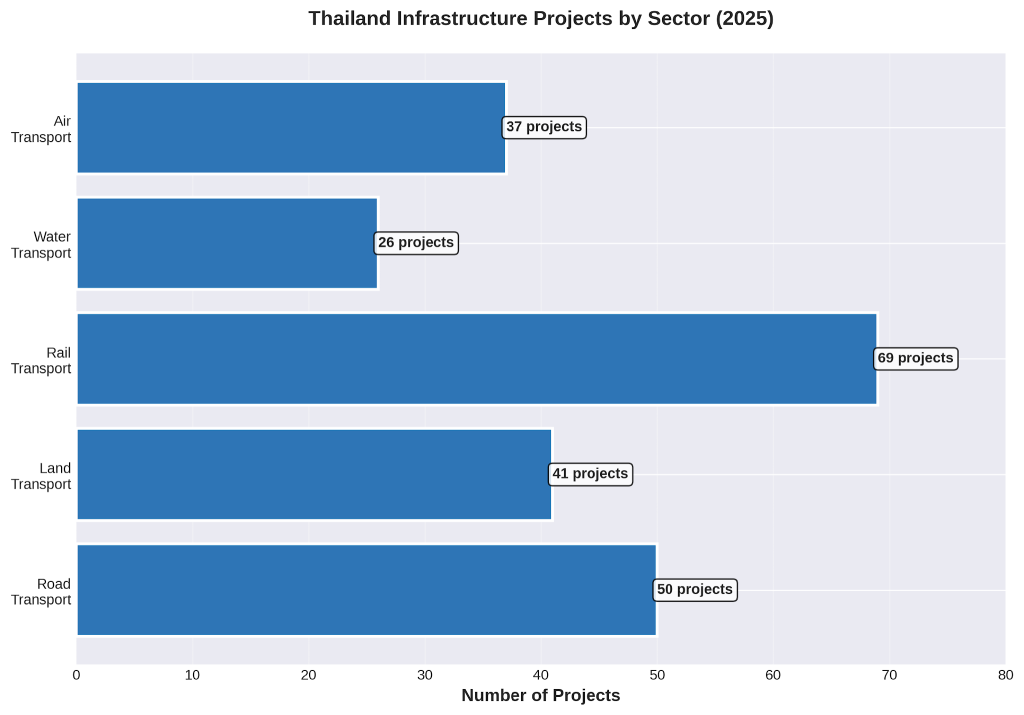
At the core of Thailand’s ambitious vision is a highly integrated infrastructure master plan spanning five critical transportation sectors. Roadways are getting a massive upgrade through 50 targeted initiatives, including the Chalong Rat Expressway extension and the M9 Bangkok Outer Ring Road, purposefully designed to slash congestion in major economic and tourism hubs like Phuket and Chiang Mai. Rail development takes center stage with 69 transformative projects, spotlighted by Phase 2 of the pioneering Thai-Chinese high-speed rail. Connecting Nakhon Ratchasima to Nong Khai, this artery will drastically cut transit times across the entire Mekong region. On the maritime front, 26 strategic projects are anchored by the Phase 3 expansion of Laem Chabang Port—the nation’s premier maritime gateway, which surged from 8.67 million TEUs in 2023 to handle 9.46 million TEUs in fiscal 2024. Meanwhile, the aviation sector is soaring with 37 projects geared toward expanding capacity at Chiang Mai, Phuket, and Suvarnabhumi airports, featuring a massive new South Terminal to meet booming passenger demand. Together, this powerful multi-modal network guarantees seamless connectivity, dramatically lowering logistics costs and cementing Thailand’s reputation as a top-tier destination for global manufacturing.
The Eastern Economic Corridor (EEC) undeniably reigns as Thailand’s crown jewel for Foreign Direct Investment, pulling in a staggering ฿660.63 billion (USD 18 billion) in just the first half of 2025. Capturing 62% of the nation’s total investment applications—a massive 43% surge from H1 2024—this 1.3-million-hectare economic powerhouse spans the prime provinces of Chonburi, Rayong, and Chachoengsao. Since its inception, the EEC has amassed over 1.35 trillion baht in total investments, operating with a laser focus on 12 future-ready sectors like next-gen automotive, intelligent electronics, and robotics. Its infrastructure is rapidly evolving to meet global demands; in June 2025, the Asian Development Bank injected a USD 68.74 million loan specifically to fast-track climate-resilient connectivity for U-Tapao International Airport, cementing the EEC’s status as a premier aviation hub. Armed with over 40 cutting-edge industrial estates, world-class port facilities, and hyper-streamlined regulations—including generous, multi-year tax holidays and fast-tracked work permits—the EEC delivers a frictionless, fully integrated ecosystem that effortlessly rivals the best manufacturing destinations in Asia.
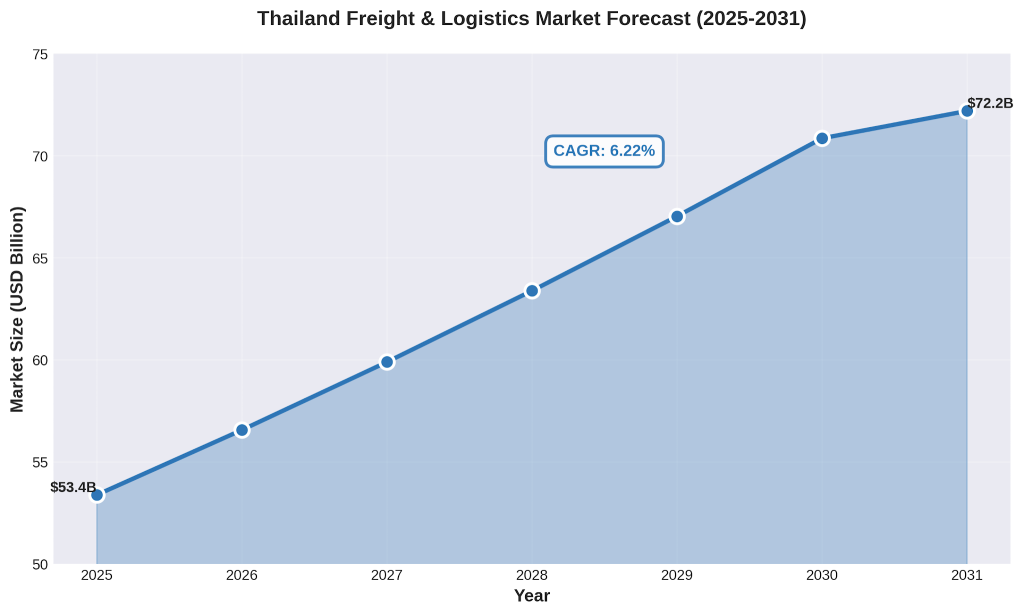
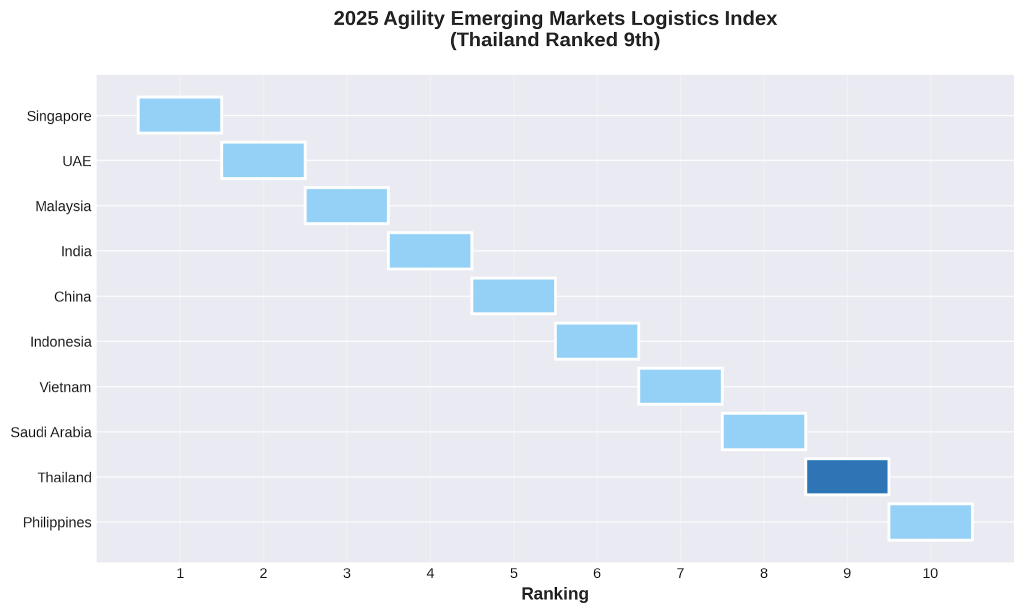
Thailand’s logistics sector isn’t just growing; it’s surging. Valued at USD 53.38 billion in 2025, the market is on a rapid trajectory to hit USD 72.19 billion by 2030—a robust 6.22% annual growth rate that underscores the Kingdom’s rising dominance. This momentum is globally recognized, with Thailand leaping to 9th place in the 2025 Agility Emerging Markets Logistics Index. Fueling this ascent is the strategic ‘China + N’ shift, as global businesses actively diversify to bulletproof their supply chains against single-market dependencies. Industry giants are already capitalizing on this: in early 2025, FedEx turbocharged its Laem Chabang facility to sort 3,000 packages an hour, seamlessly bridging the Asia-Pacific and European markets. Simultaneously, the Port Authority of Thailand is revolutionizing domestic transit by mapping out 360 kilometers of strategic waterways—including the Nan, Mae Lao, and Kok rivers—to heavily optimize cargo flows. For manufacturing executives, the payoff is clear and immediate: drastically reduced time-to-market, slashed logistics costs, and a highly resilient supply chain engineered to withstand global disruptions.
Situated right at the beating heart of ASEAN, Thailand unlocks unparalleled access to a dynamic market of over 680 million consumers, boasting a combined GDP of USD 13.152 trillion in purchasing power. This strategic advantage is massively amplified by the Regional Comprehensive Economic Partnership (RCEP). Since taking effect in 2022, RCEP has forged the world’s largest trade bloc—uniting ASEAN with economic heavyweights like China, Japan, South Korea, Australia, and New Zealand. The impact is undeniable: in 2024, Thailand’s RCEP partners accounted for a staggering 57.3% of its exports and 61.2% of its imports. Refusing to rest on its laurels, the Thai government is aggressively expanding its global footprint by negotiating 11 new free trade agreements, targeting key markets like the EU and Canada to further diversify access. Meanwhile, the region’s digital economy is roaring toward a projected USD 2 trillion by 2030, fueled by seamless cross-border e-commerce and integrated digital services. Crucially, the rollout of the Unique Business Identification Number (UBIN) means Thai manufacturers are now instantly recognized across all ASEAN borders, slashing administrative red tape and supercharging transaction speeds. Ultimately, this hyper-connectivity elevates Thailand beyond a mere production hub, transforming it into the ultimate gateway for conquering the vast Asia-Pacific market.
CONCLUSION
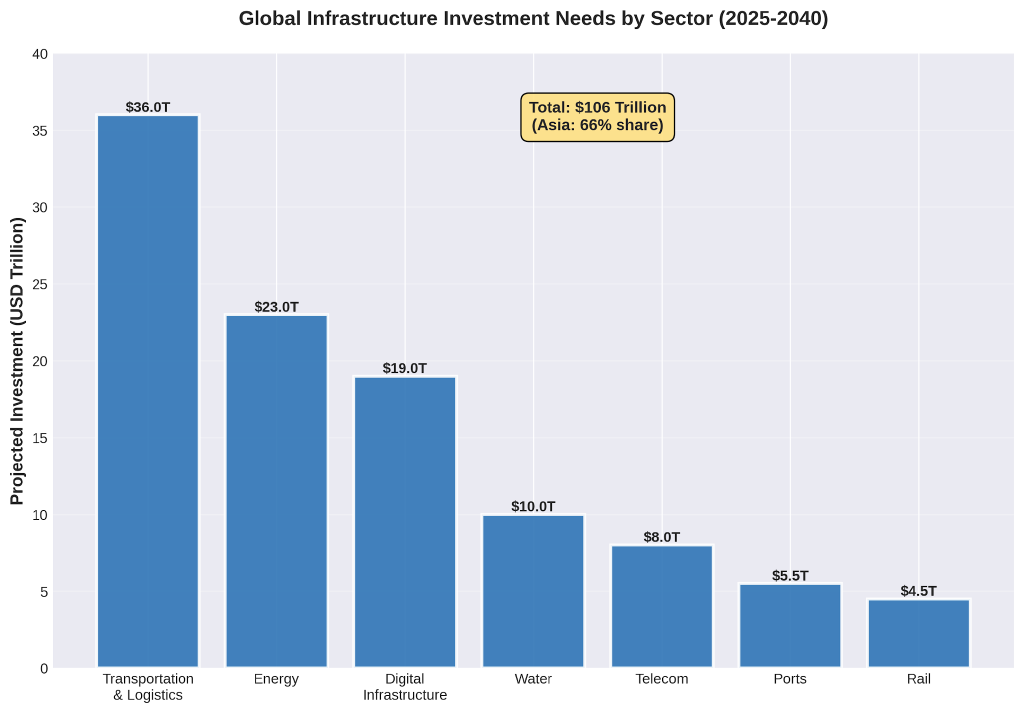
The global infrastructure landscape is accelerating toward a monumental USD 106 trillion investment wave by 2040. Driven by rapid urbanization, Asia is set to capture two-thirds of this capital, focusing heavily on transportation, energy, and digital networks. Thailand is strategically positioning itself at the very heart of this boom. The crown jewel of its master plan is the ฿997 billion Southern Economic Corridor Land Bridge—a massive initiative featuring dual deep-sea ports, double-track railways, and extensive pipeline networks. Designed to offer a highly efficient, lucrative alternative to the congested Strait of Malacca, its first phase is slated to open by 2030. Furthermore, the Ministry of Transport is actively advancing 11 new Public-Private Partnership megaprojects worth ฿359.8 billion for 2026. For manufacturing leaders seeking long-term strategic locations, this robust project pipeline serves as an ironclad guarantee that Thailand’s connectivity, capacity, and competitive edge will only grow stronger in the decades ahead.
Article by: Asst. Prof. Suwan Juntiwasarakij, Ph.D., Senior Editor & MEGA Tech