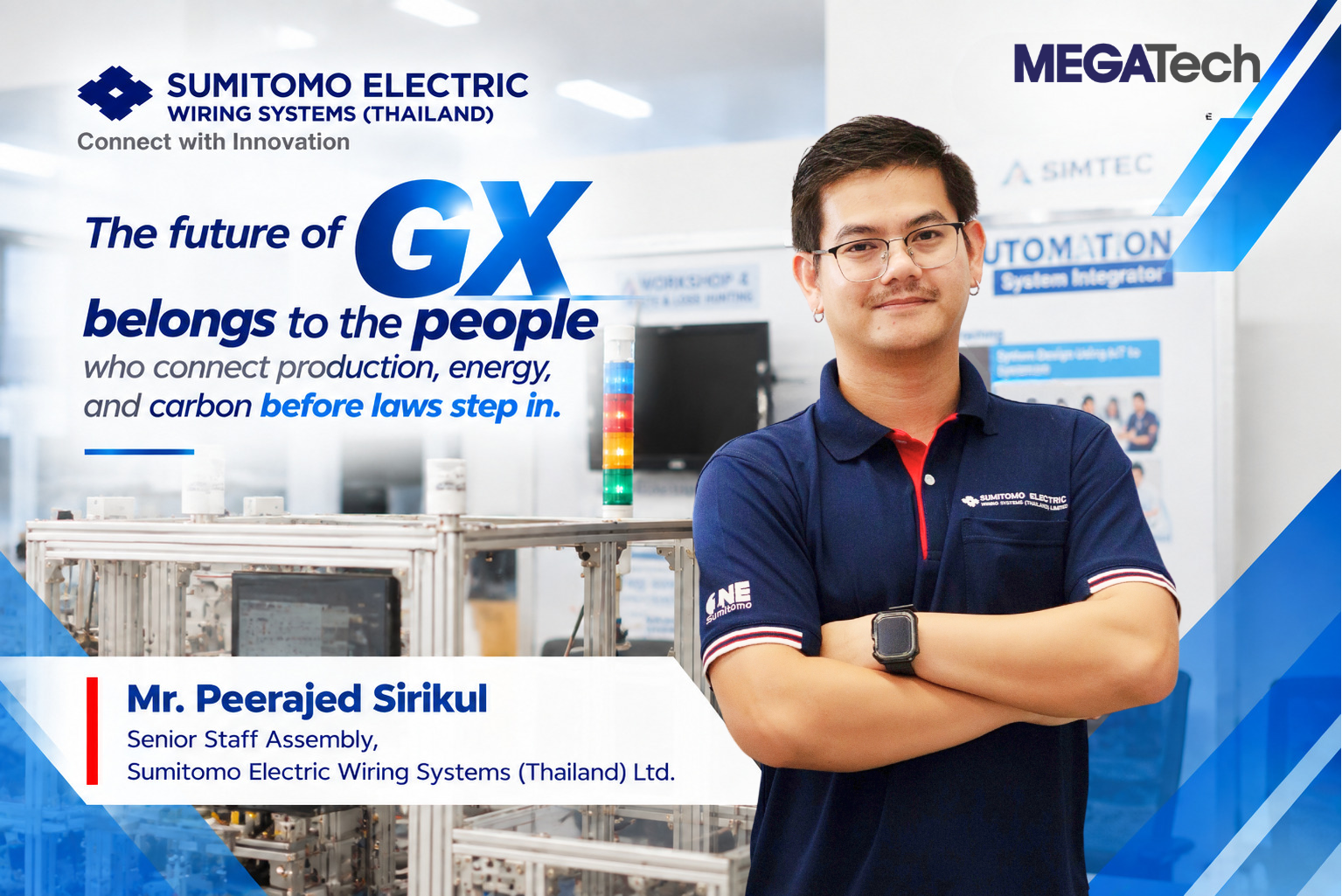
From production expertise to a broader vision encompassing Data, Energy, Loss, Waste, and Carbon: Unveiling the perspective of Mr. Peerajed Sirikul after completing four days of SEEN – LEAN – GREEN – CLEAN.
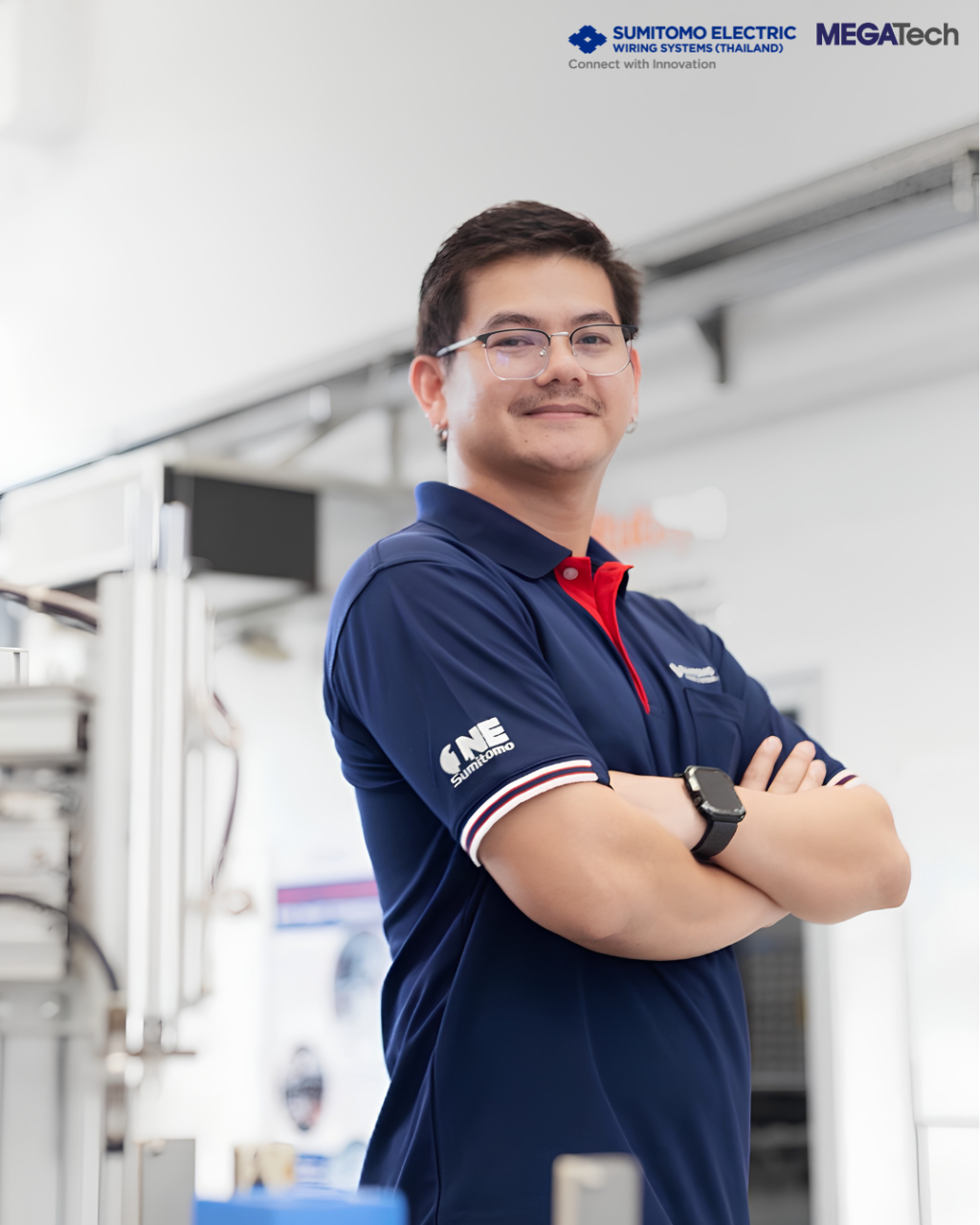
Sumitomo Electric Wiring Systems (Thailand) Ltd.
MEGA Tech had the opportunity to speak with Mr. Peerajed Sirikul, Senior Staff Assembly at Sumitomo Electric Wiring Systems (Thailand) Ltd., following his participation in SIMTEC’s “GREEN TRANSFORMATION for Next-Generation Factory Leaders” program. What stands out is not merely his increased knowledge of Green Transformation, but the fresh perspective of a pure production practitioner who stepped beyond his traditional domain to understand Energy, IoT, and Carbon—topics typically considered the responsibility of Maintenance or Facility teams. He discovered that this body of knowledge directly addresses core production challenges: identifying loss and waste, gaining visibility into machinery efficiency, and utilizing data to precisely optimize manufacturing processes.
Unlocking Traditional Boundaries: Why Energy & Carbon Knowledge Must Be Shared Across the Entire Factory
Prior to joining the course, Mr. Peerajed admitted that those not working directly in energy-related roles might have limited understanding of the field, given their primary background in production, whereas energy management typically fell under Maintenance or Facilities. Furthermore, this SIMTEC training marked his first in-depth exposure to Carbon Credits.
“Previously, our expertise was heavily centered on production, while our understanding of energy was not as deep,” said Mr. Peerajed. “Participating in this program provided a wealth of new insights, and it became clear that this knowledge can be immediately applied to enhance our production operations.”
When energy and environmental insights are connected directly to those driving the production line, the overall perspective within the factory transforms completely. The focus expands from purely evaluating Output, Cycle Time, and Productivity to acutely identifying Loss, Waste, and energy inefficiency embedded within the exact same manufacturing processes.
Reframing the Mindset: From Production Loss to Energy Loss for Line Optimization
Mr. Peerajed views the comprehensive insights gained over the four-day program as highly practical for tangible, end-to-end organizational implementation:
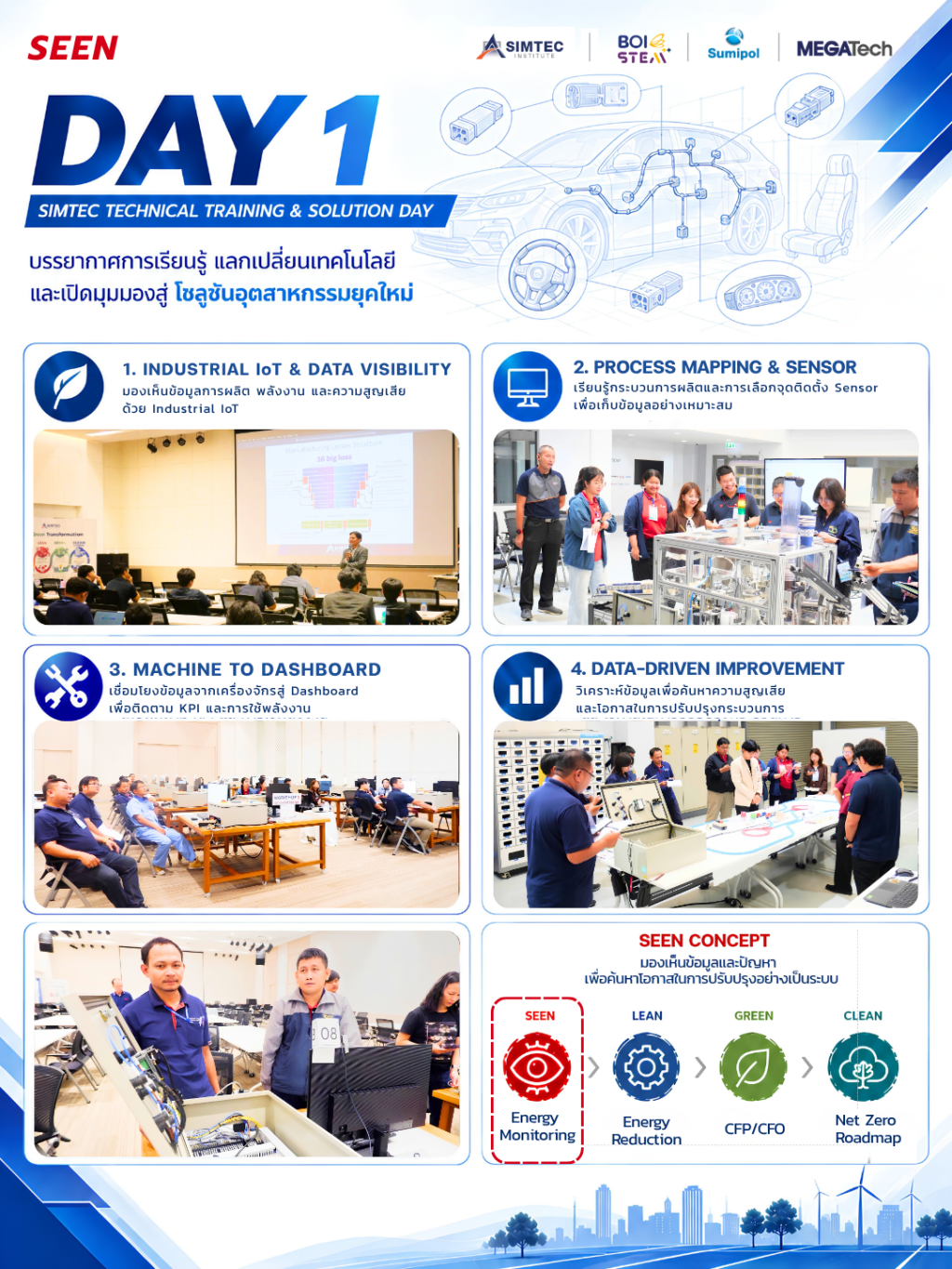
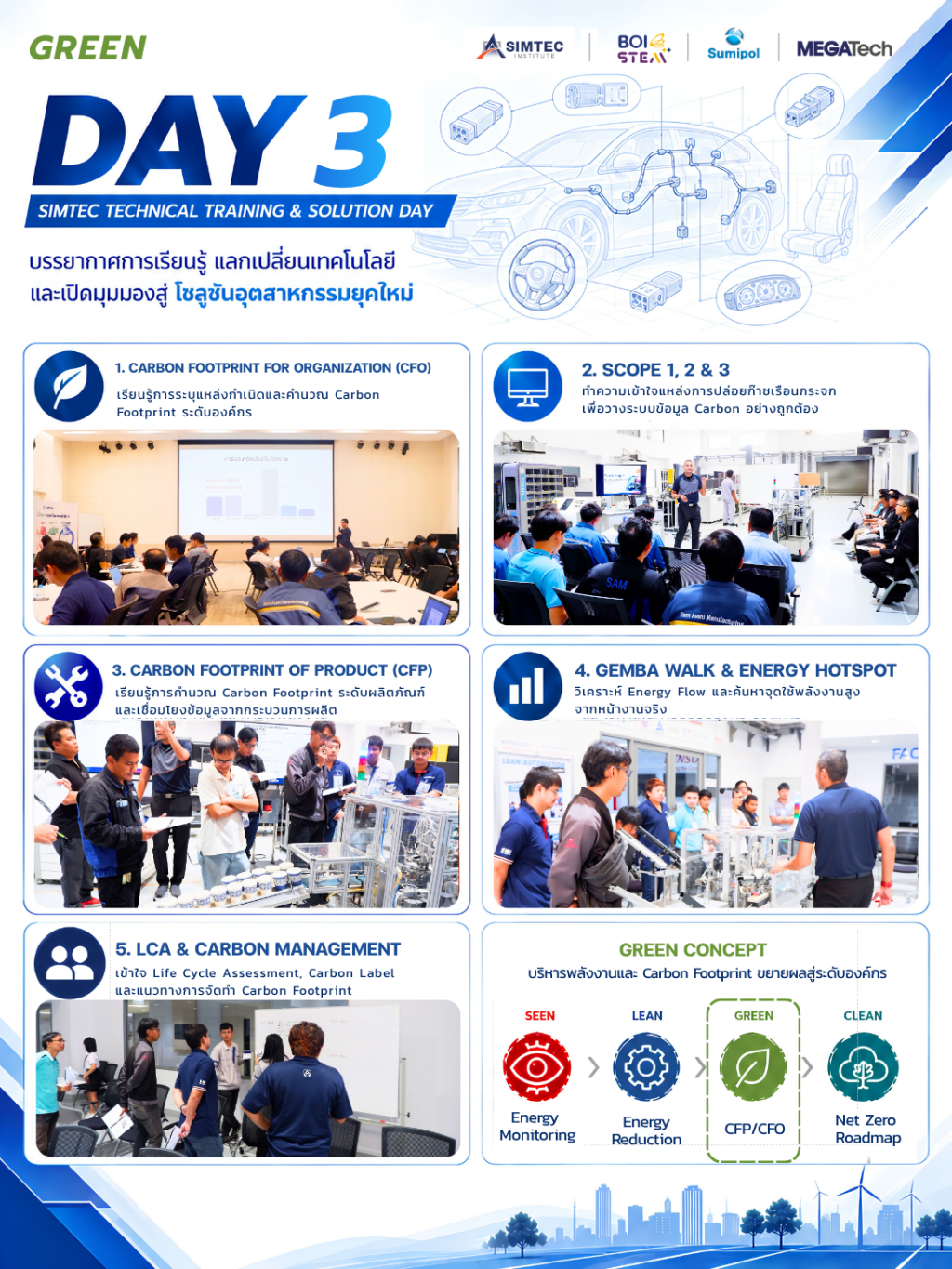
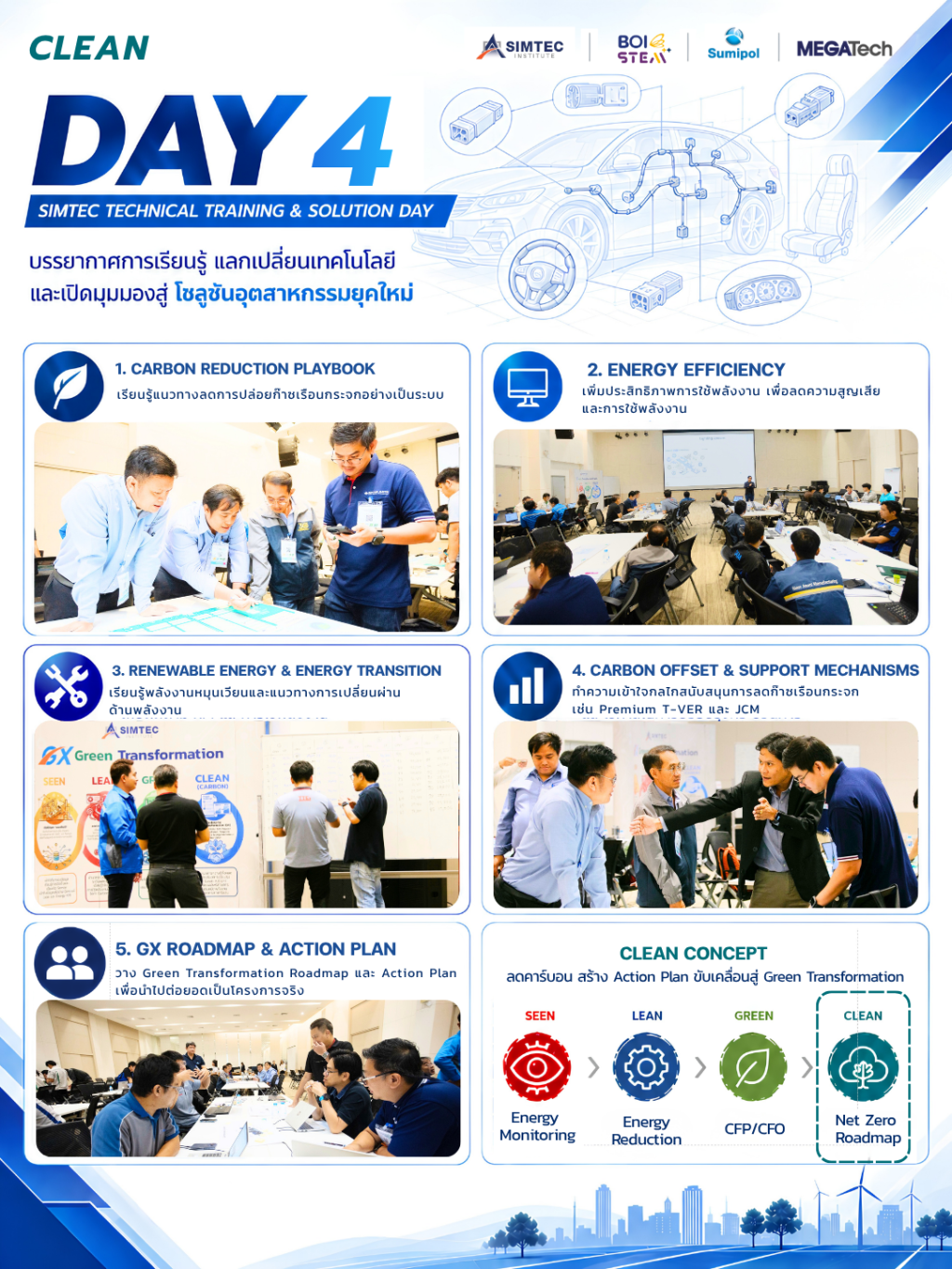
- SEEN: Transforms shop-floor data into clear, visible problems.
- LEAN: Identifies and eliminates process loss and operational waste.
- GREEN: Elevates the strategic framework toward energy management and Carbon Footprint reduction.
- CLEAN: Unlocks a roadmap for systematic, long-term organizational development.
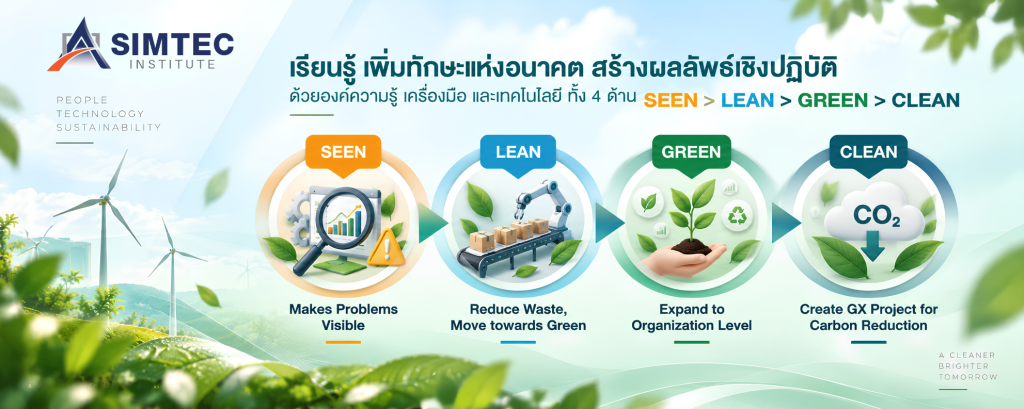
The case study that most vividly illustrates production work is the issue of compressed air leakage. It proved that air leaks are no longer just a task for the Maintenance department, but represent direct energy loss and hidden production costs. This course adds a whole new dimension to “process improvement,” showing that reducing loss does not stop at improving speed or minimizing downtime, but involves unearthing the hidden energy costs behind those operational wastes.
When Data Shifts Perspectives: Unlocking Visibility to Target Front-Line Challenges
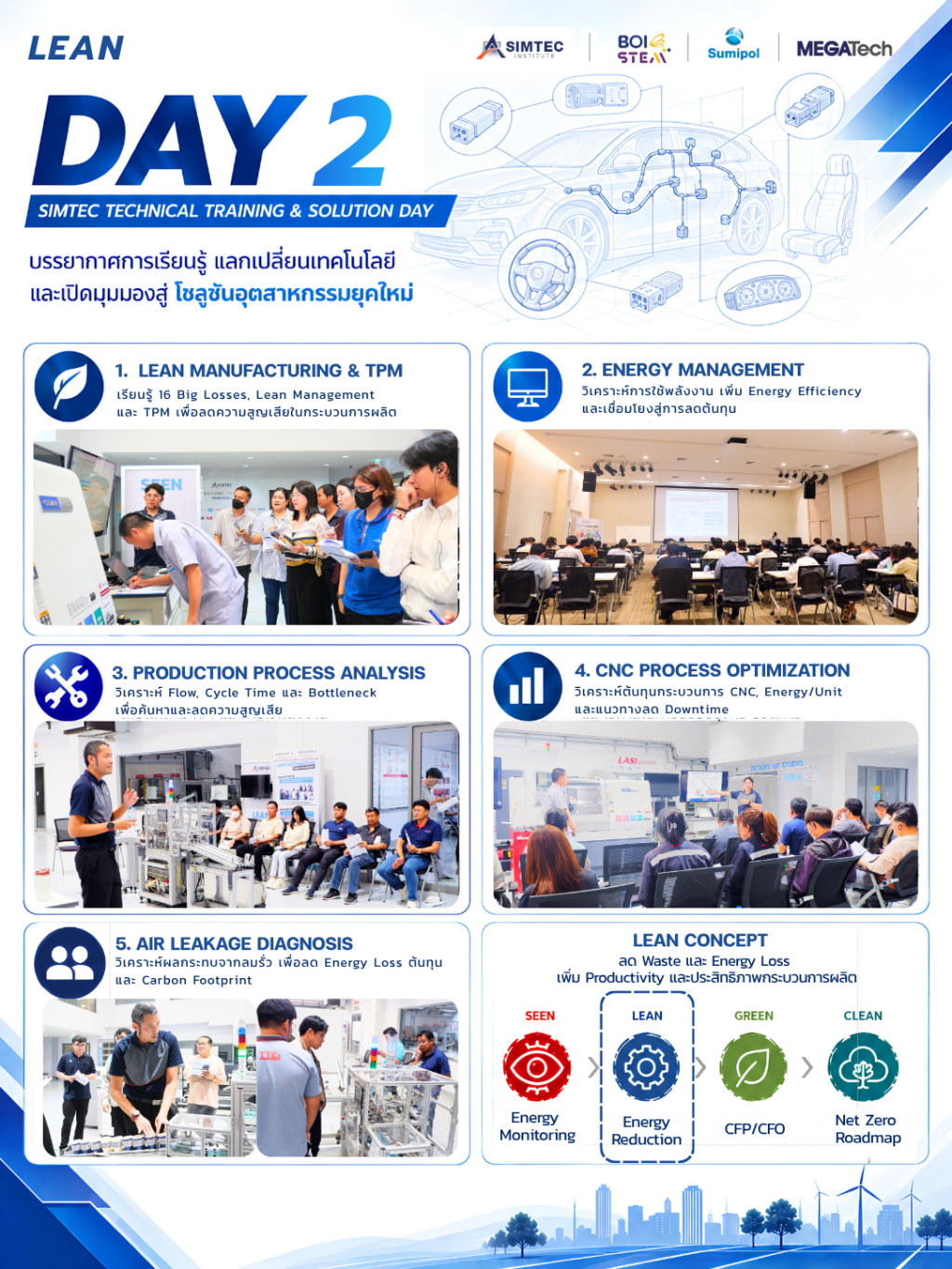
What left the strongest impression and revealed the clearest opportunity for practical implementation was IoT technology and dashboard design within the SEEN module. Although the factory already utilizes IoT systems, the workshop sparked new realizations that data can be designed and analyzed at a much deeper level to uncover root causes far more effectively than before.
“What impressed me right from day one was the IoT Dashboard, because we can customize it according to our specific objectives—such as tracking machine efficiency or pinpointing losses at specific locations. This allows for rapid data access and makes line improvements much simpler,” Mr. Peerajed highlighted.
For production personnel, the definition of SEEN is no longer just installing sensors or displaying a dashboard, but precisely defining what needs to be seen. This transforms raw data into strategic decision-making tools that genuinely elevate manufacturing efficiency.
From Workshop to Action Plan: Moving from “Understanding” to Concrete Executive Proposals
The insights gained from the course did not end as mere post-training impressions. Mr. Peerajed mapped out a clear roadmap to aggregate the workshop data and results, compare them against the factory’s current operations, and formulate a strategic proposal for top management.
“I intend to compile all the data to present to management. I want to show what new opportunities we discovered following the training and workshops, how our current setup differs from what we learned at SIMTEC, and where our existing gaps lie.”
Particularly regarding IoT technology, Mr. Peerajed noted that the granular data quality experienced during the course can identify root causes quickly and accurately. This reduces workload and time for front-line staff while significantly driving efficient production line improvements. Consequently, he plans to propose that the SIMTEC team conduct a live demonstration on site to assess feasibility before expanding onto the factory’s existing systems.
Carbon May Not Be Today’s Urgent Mandate, But “Readiness” Should Not Wait for Regulation
Although parent companies and international networks have already rolled out explicit carbon reduction policies, direct carbon management measures for plants in Thailand remain in their early stages. Nevertheless, Thailand has continuously driven energy and environmental initiatives, including reducing power and water usage, installing solar cells, and running internal campaigns. This training serves as a strategic milestone to align shop-floor readiness with global policies before compliance becomes strictly mandatory.
“Bringing this knowledge back to develop our organization will deliver immense future value. When new laws or regulations are eventually enforced, we will already possess the knowledge base to apply them immediately,” he emphasized.
For a production specialist with no prior carbon training, understanding systems like CFO, CFP, Scope 1, 2, and 3—alongside linking energy consumption to carbon output—opened a clear new mindset: factory readiness must begin today, long before regulatory demands become a forced burden.
Transmitting Knowledge from Plant to Organization: A Journey Transforming Every Factory
What makes this journey particularly noteworthy is that learning does not end with a single cohort. The corporate group operates three manufacturing plants. The first plant has already completed training, while the remaining two are preparing to send their teams in upcoming batches. The knowledge embodied in SEEN – LEAN – GREEN – CLEAN is expanding from an individual group to create a shared organizational alignment. This demonstrates that the true value of the curriculum does not end with a certificate or a workshop conclusion; it begins bearing fruit the moment participants return to challenge legacy processes, analyze previously overlooked data, present insights to management, and share knowledge with colleagues.
For Mr. Peerajed, his four-day journey began as a “production professional with no direct energy duties” and concluded with a broader, deeper perspective of the entire factory—where Productivity, Loss, Waste, Energy, Data, and Carbon seamlessly converge into a single cohesive story.
As the manufacturing sector moves toward mandatory energy, carbon, and sustainability standards, competitive advantage will not belong to those who start adapting on the day the law arrives, but to organizations that build understanding and “prepare their people” in advance starting today.
Executive Takeaway
“The factory of the future may not simply require more advanced technology, but rather ‘people’ who can accurately see the interconnectedness of Production, Energy, and Carbon… before regulations force them to change.”
Mr. Peerajed Sirikul, Senior Staff Assembly
Sumitomo Electric Wiring Systems (Thailand) Ltd.