“Today’s leadership challenge is not simply declaring a Net Zero target on paper, but fostering understanding and equipping tens of thousands of employees to practically move toward a green industry.”
In an era where the automotive and auto-parts industries are undergoing a major transition, Thai Summit Group, a leading global auto-parts manufacturer, has stepped up as a key organization driving a robust sustainability strategy.
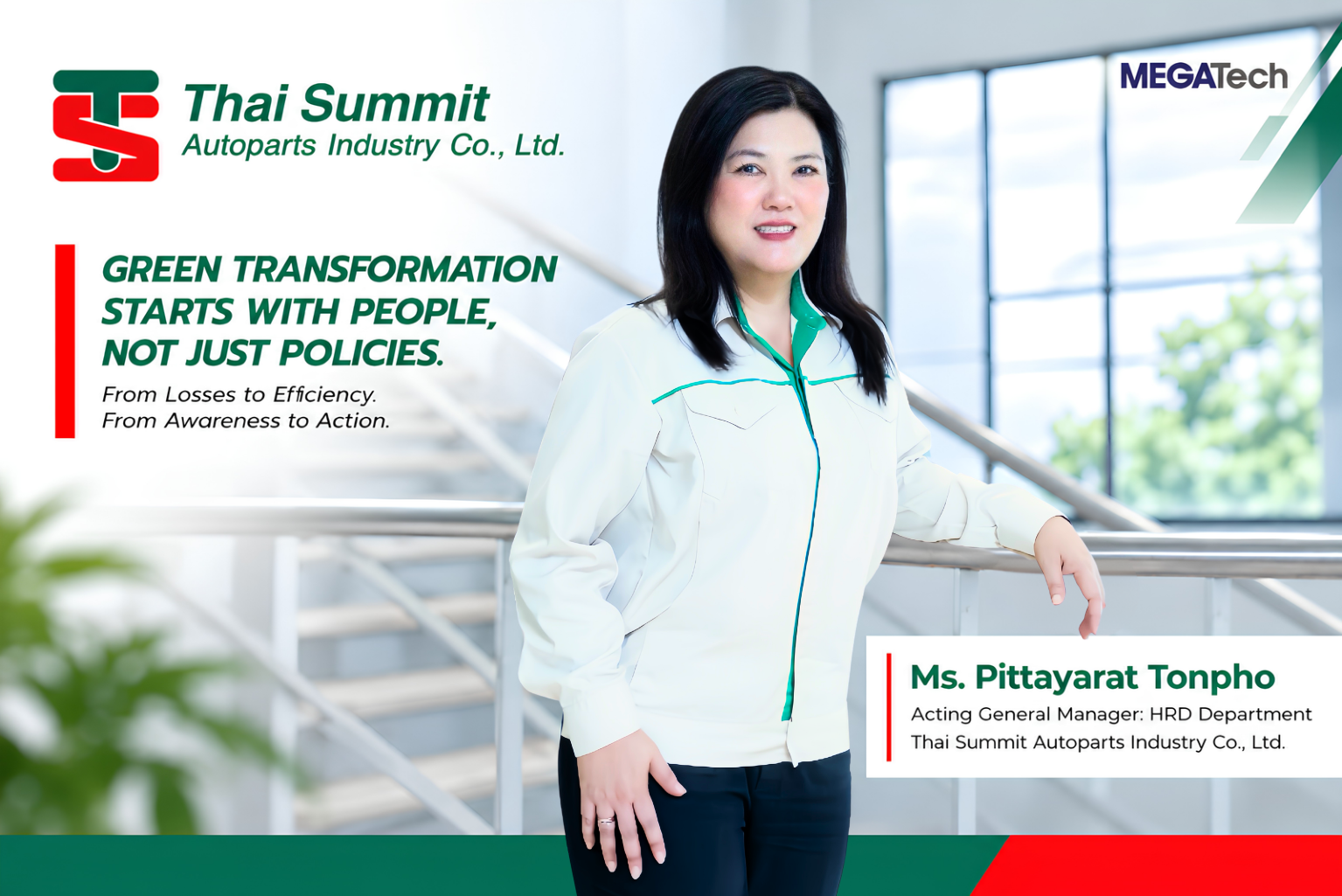
MEGA Tech joined an in-depth vision-sharing session with Ms. Pittayarat Tonphho, Acting General Manager of the HRD Department at Thai Summit Autoparts Industry Co., Ltd. She shared insights on setting this strategic sustainability roadmap following her participation in the “GREEN TRANSFORMATION for Next-Generation Factory Leaders” course by the SIMTEC Institute. The discussion highlighted organizational direction, building employee foundations, and linking the SEEN → LEAN → GREEN → CLEAN framework directly to business performance across domestic and international subsidiaries.
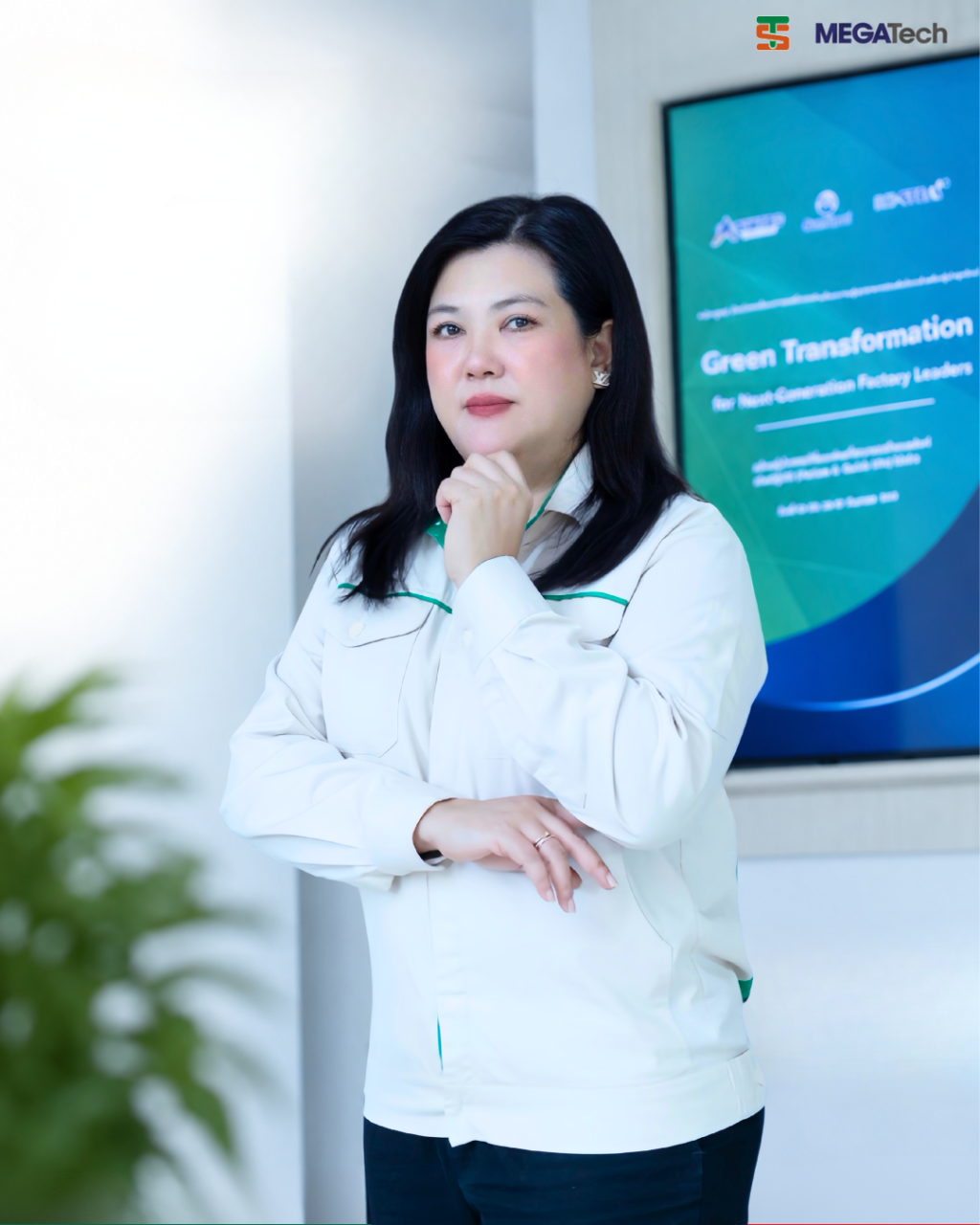
Acting General Manager: HRD Department,
Thai Summit Autoparts Industry Co., Ltd.
Linking Green to Business Performance: Transforming Foundations for Global Competitiveness
Ms. Pittayarat began by reflecting on the macro perspective, emphasizing that for large industrial entities, Green Transformation cannot be viewed in isolation from financial performance.
“Many people view ‘Green’ merely as an environmental matter or legal compliance. However, at Thai Summit, we see it as directly linked to productivity and business performance,” Ms. Pittayarat explained.
“Industrial plants already possess a strong foundation in technology, machinery, and smart systems (AI & Smart Industry). When we apply the SEEN → LEAN → GREEN → CLEAN principles, it enables us to uncover waste, cut energy costs, and effectively reduce greenhouse gas emissions. This is not just corporate social responsibility (CSR); it is about raising our competitive edge in global supply chains.”
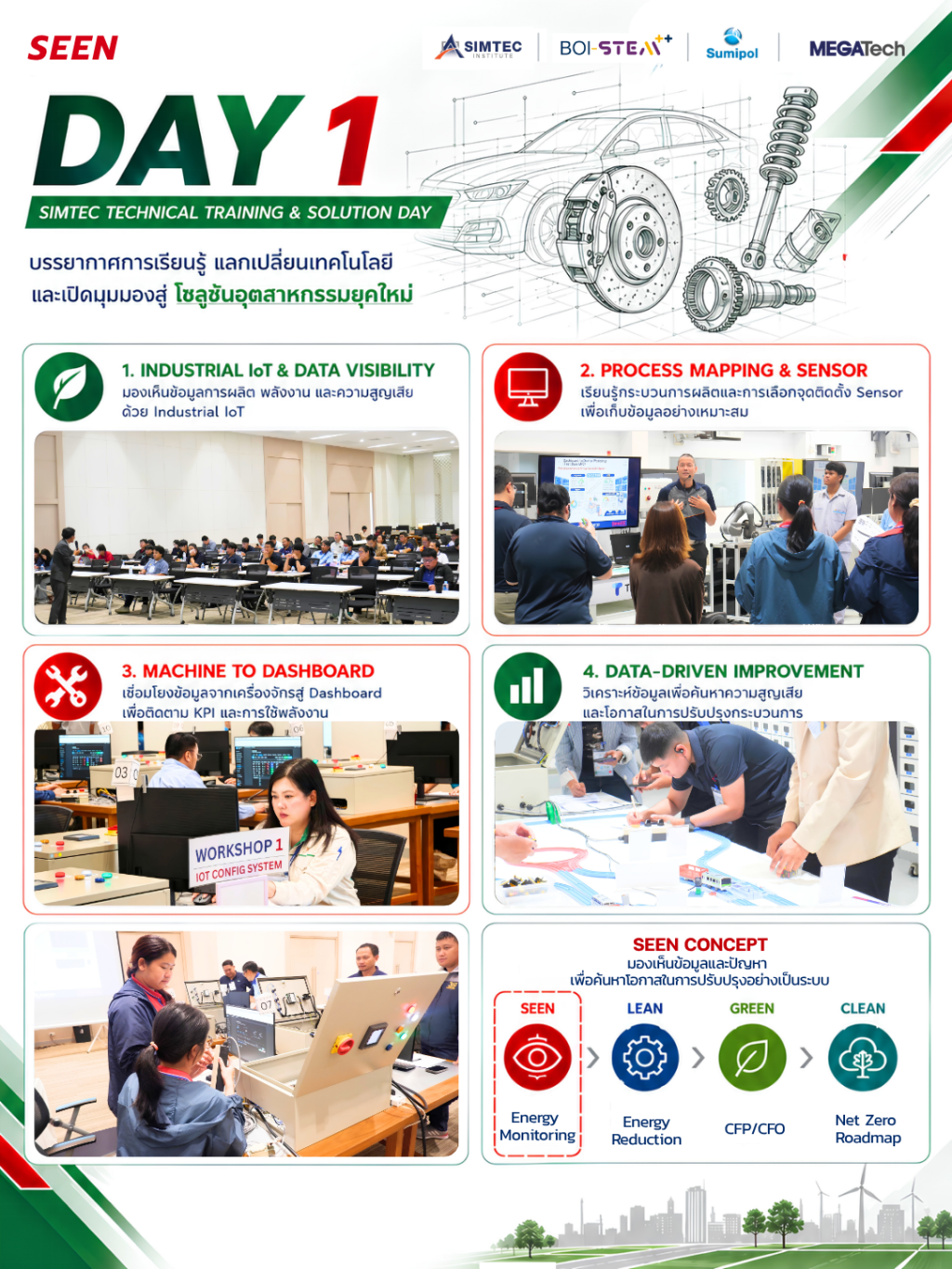
Filling the Missing Puzzle Piece: From Carbon Calculations to “Practical On-Site Machinery Action”
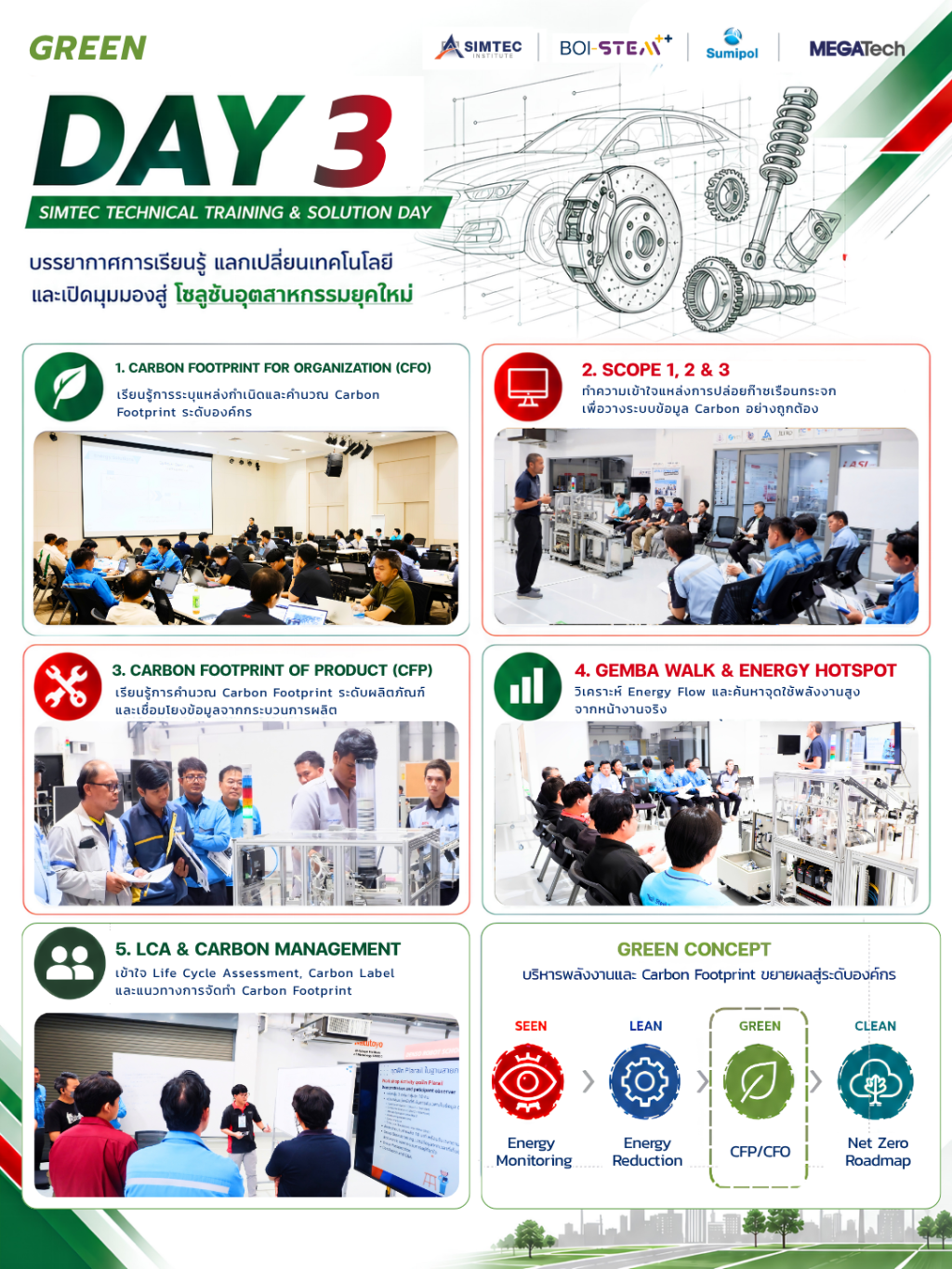
As an executive who previously completed advanced training in Carbon Footprint for Organization (CFO) and Carbon Footprint for Product (CFP), Ms. Pittayarat pointed out the unique strengths and value of SIMTEC’s curriculum.
“Previously, learning about carbon footprint calculations focused heavily on carbon credits, academic theories, and numerical formulas. What SIMTEC filled in almost 100% was connecting carbon reduction theory directly to real shop-floor machinery and production equipment.”
“This course provided a clear picture of where to start leaning in practice, where energy leaks occur, and how to apply industrial technology to improve front-line shop floors. Consequently, carbon management is no longer an abstract concept, but a tangible Action Plan that shop-floor technicians and engineers can actively execute.”
SEEN → LEAN → GREEN → CLEAN: A 4-Step Roadmap for Cost-Effective Investment
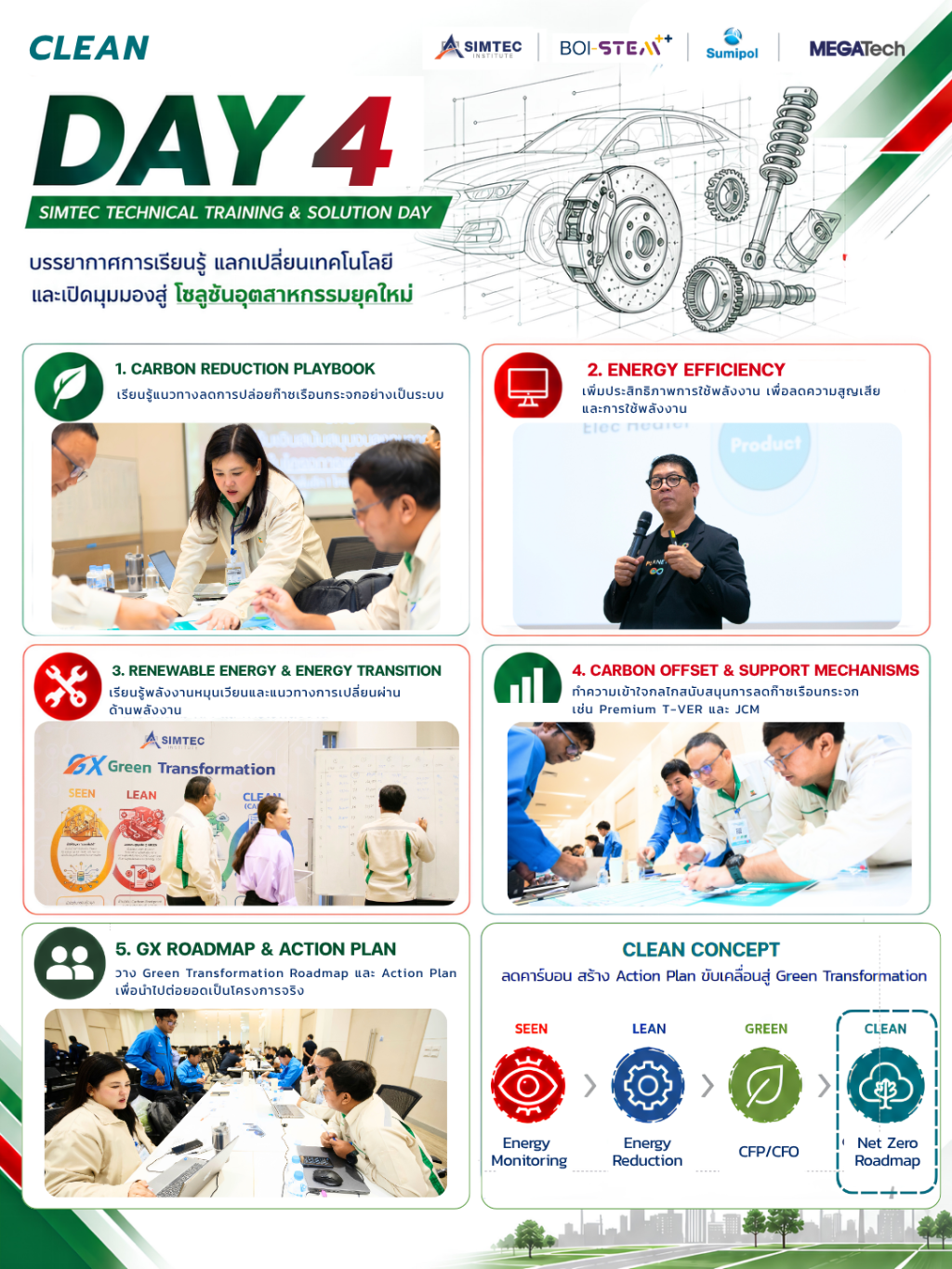
Ms. Pittayarat elaborated on the realization of the SEEN → LEAN → GREEN → CLEAN framework, which serves as a new operational structure to prioritize actions before making strategic investment decisions.
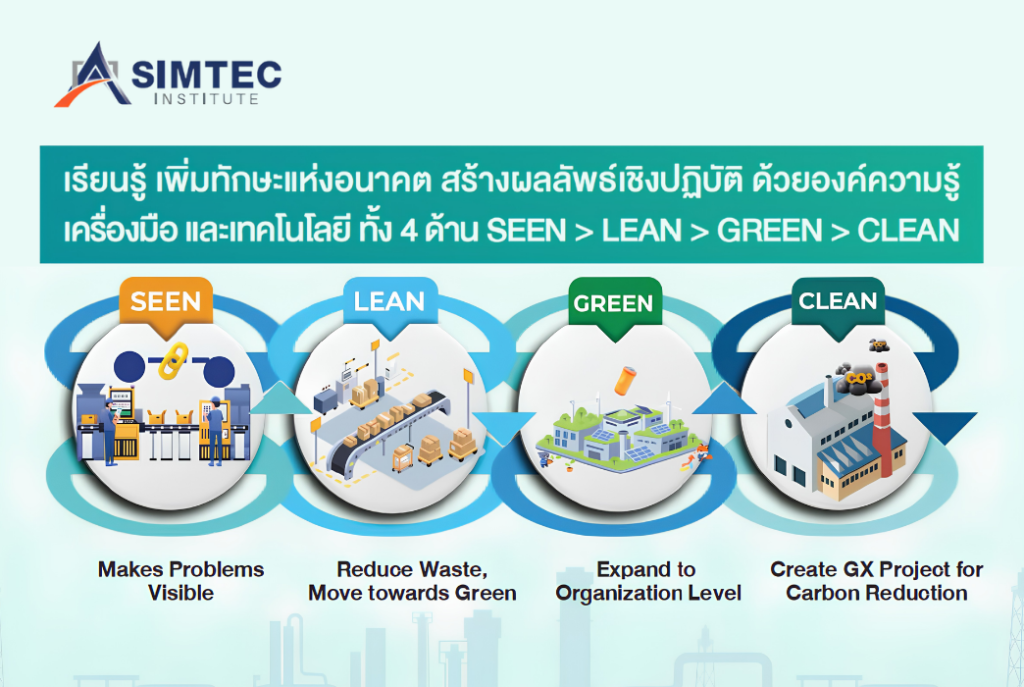
“Before deciding to invest in new technologies, it is essential that we first go through the steps of making issues visible (SEEN) and eliminating waste (LEAN).”
- SEEN (Visualization): Establish objective data to make operational leaks and waste visible across processes.
- LEAN (Waste Elimination): Streamline production processes, eliminate energy loss, and reduce operating costs.
- GREEN (Carbon Management): Systematically calculate and reduce the carbon footprint based on Lean outcomes.
- CLEAN (Achieving Sustainability): Develop long-term innovation and management practices toward Net Zero targets.
“Sequencing the steps this way prevents organizations from making unnecessary investments in new technology and ensures that cost, energy, and carbon reduction planning is pointed in the right direction.”
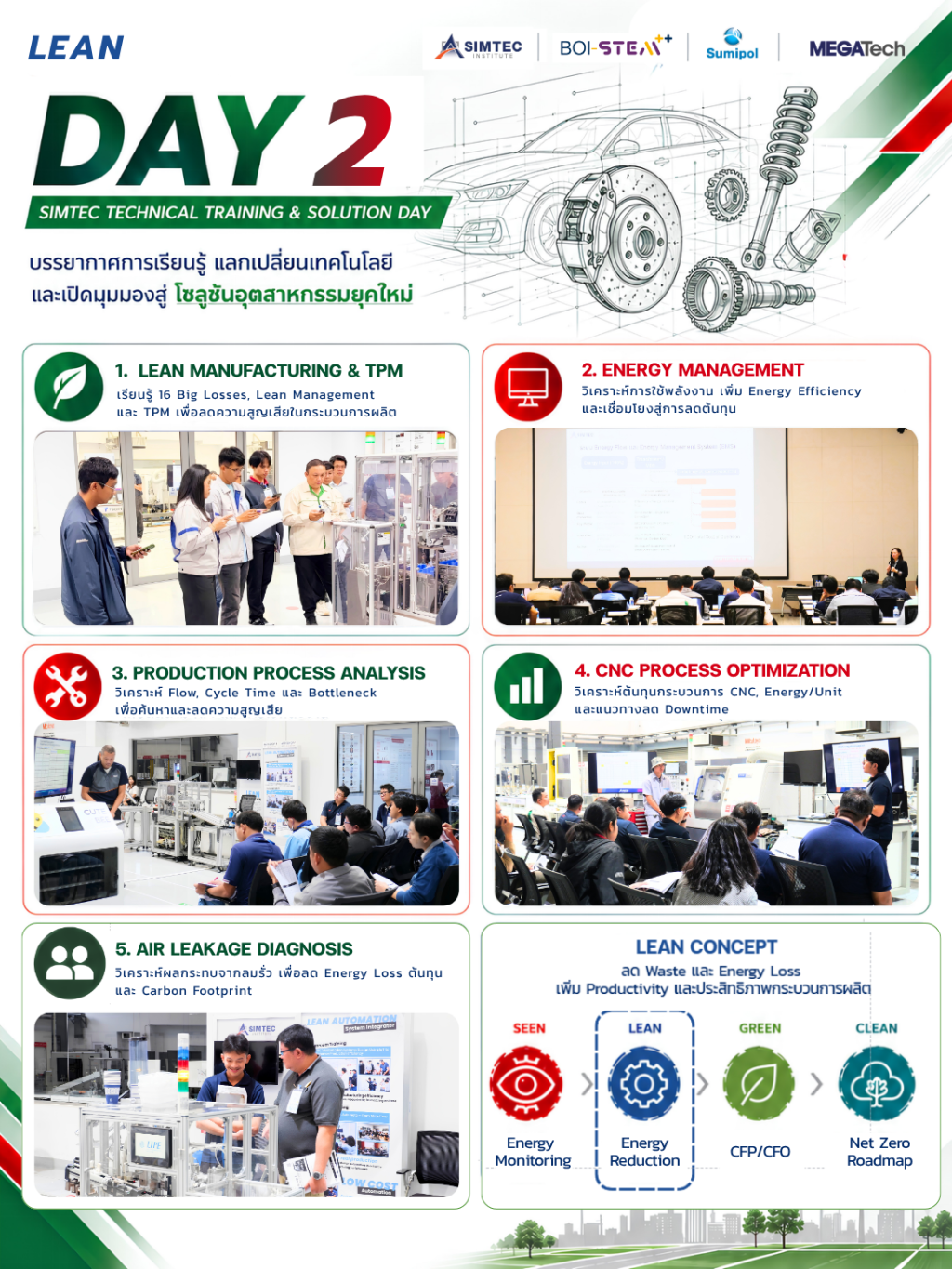
Driving Corporate Goals: Reducing Carbon by 15% While Elevating Capabilities to Meet Global Demand
At the policy level, Thai Summit is preparing for a major strategic move, with Headquarters setting clear targets to systematically steer toward sustainability.
“Thai Summit HQ has incorporated key targets into our business plan, starting with a goal to reduce greenhouse gas emissions by 15% by 2030. Although we are not an OEM exporting cars directly to Europe, as a crucial Tier-1 supplier to major automakers like Ford, Toyota, Isuzu, and others, we recognize the shifting market demands and serious commitments from vehicle manufacturers,” said Ms. Pittayarat.
“Preparing in advance is vital. Achieving a 15% carbon reduction is not something accomplished overnight; it requires laying strong conceptual and operational foundations across all group subsidiaries.”
People Readiness: Building Human Resources as the Key to Sustainability
For an organization spanning over 30 group companies in Thailand and 11 abroad, supported by tens of thousands of personnel, successfully driving a Green strategy must begin with people.
“Thai Summit Group places immense priority on preparing our people at every level. We established a committee led by the Quality System Management (QSM) team to act as the core driving force. However, the vital heart of this initiative is ensuring that operational employees in the plants understand what Carbon Credits and Net Zero actually mean, and how these concepts relate to their daily responsibilities.”
“In overseeing Human Resource Development, my immediate priority is encouraging and communicating with teams and supervisors across our group companies to continuously join the SIMTEC training programs. We have already sent executives and staff across several cohorts and plan to send many more. We firmly believe that when our people possess the right skills, knowledge, and mindset tools, driving our organization toward our 15% Green Manufacturing target will become a sustainable reality,” Ms. Pittayarat concluded.
Executive Takeaway
“Executing a Green Transformation in a large organization is not simply about enforcing top-down regulations. It is about empowering personnel at every level to understand the core interplay of ‘Machinery–Energy–Processes’ through the SEEN → LEAN → GREEN → CLEAN framework, turning operational waste into lasting organizational sustainability.”
Ms. Pittayarat Tonphho, Acting General Manager, HRD Department
Thai Summit Autoparts Industry Co., Ltd.