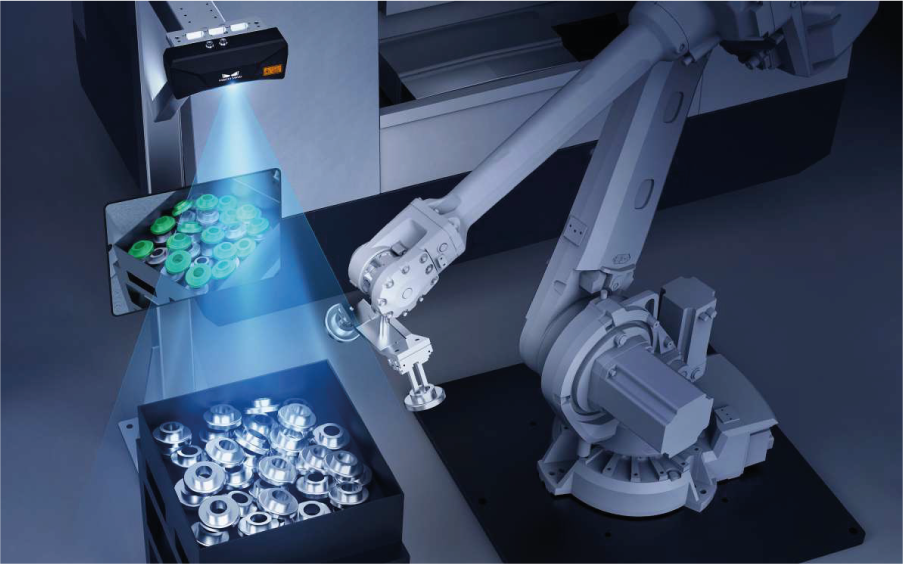
Traditional industrial robots excel only when parts are presented in fixed, precise coordinates. In real-world manufacturing, however, parts are often heaped randomly, feature complex geometries, possess highly reflective surfaces, or constantly change orientation. Today’s automation can no longer rely on rigid pre-programming; it demands a system capable of true real-world perception and contextual understanding.
MEGATech explores the next frontier of Intelligent Automation through Mech-Mind’s AI + 3D Vision solution (presented by JSR GROUP). By seamlessly integrating 3D scanning, machine vision, deep learning, and advanced robot control software, this technology transforms robots into intelligent agents capable of perceiving and handling objects dynamically—paving the way for unprecedented line flexibility.
Beyond Pre-Set Coordinates: Perceiving and Detecting Objects in Real-World Conditions
Imagine a bin stacked with numerous metal components—some upright, some inverted, and others tilted at arbitrary angles. While picking these parts is effortless for a human operator, an automated robot must analyze part orientations, calculate precise grip angles, and plan collision-free trajectories in real time.
This real-world detection process operates through two core stages:
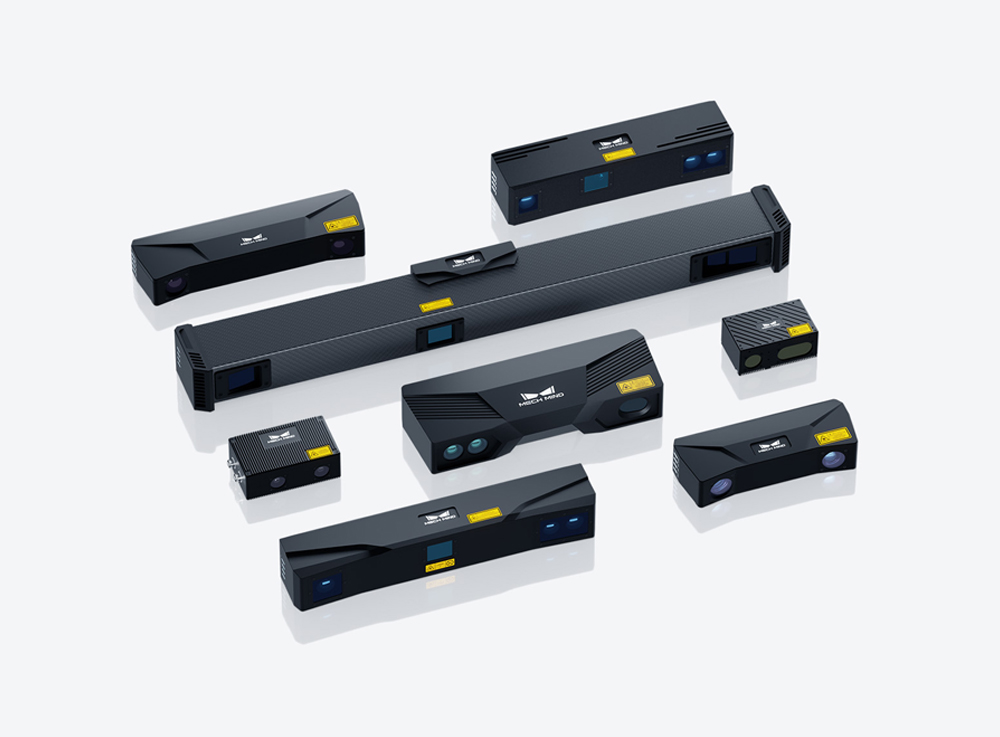
- 3D Model Generation: The Mech-Eye Industrial 3D Camera scans object surfaces to capture real-time, high-density 3D point cloud data.
- Pose & Spatial Analysis: The vision system ingests this data to accurately identify the 3D position, geometric structure, and precise orientation of every individual component.
Mech-Mind’s 3D vision technology overcomes traditional imaging limits by reliably processing notoriously challenging workpieces—including shiny, highly reflective metal parts, complex geometries, and randomly scattered layouts. This capability enables robots to operate flawlessly within highly flexible, real-world production environments.
Breaking Conventional Limits with Intelligent Random Bin Picking
Among the most transformative applications in modern manufacturing is Random Bin Picking—instructing a robot to autonomously detect and pick jumbled, overlapping components stored randomly in deep bins. This task has long posed a severe challenge for conventional automation systems.
By coupling 3D vision with intelligent algorithms, Mech-Mind empowers robots to execute bin picking with high efficiency and reliability:
- Picking Strategy & Object Recognition: Powered by Mech-Vision software, the system identifies part locations, categorizes workpieces, and determines optimal grasping strategies.
- Path Planning & Collision Detection: Utilizing Mech-Viz software, the system calculates motion trajectories and simulates movements in advance, ensuring the robotic arm and gripper avoid collisions with bin walls or adjacent parts.
- Graphical & Code-Free Interface: Designed with an intuitive, fully visual, code-free interface, the software allows automation engineers to configure and deploy applications quickly and effortlessly.
Vision-Guided Machine Tending: Elevating Loading and Unloading Operations
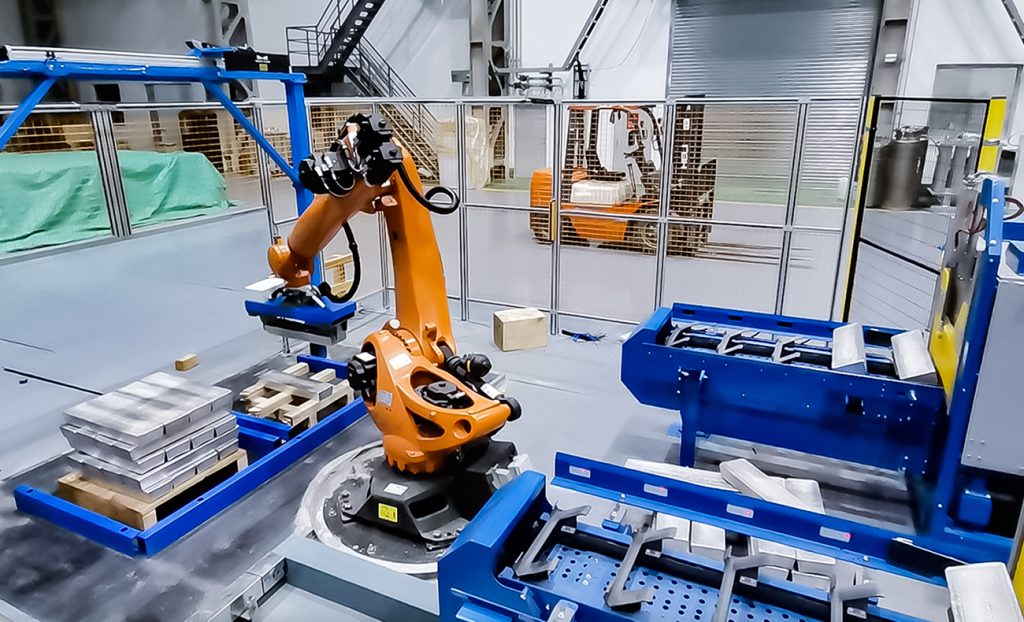
Another flagship application delivered by Mech-Mind is Machine Tending—utilizing robots to load, unload, or transfer workpieces to and from production machinery and processing lines.
The core advantage of Vision-Guided Machine Tending lies in the robot’s ability to detect parts of varying sizes, geometries, and orientations—even when workpieces feature reflective surfaces or are stacked randomly—prior to picking and placing them with pinpoint accuracy.
Mech-Mind’s 3D vision system elevates machine tending across the metalworking and automotive industries into fully autonomous operations. It scans and determines the precise 6D pose of diverse components—such as gears, motor housings, steel bars, and brake drums. The high-precision coordinate data is then transmitted to the robot for seamless loading and unloading, enabling continuous, reliable operation without human intervention.
The Eye–Brain–Hand Synergy: From Perception to Real-World Execution
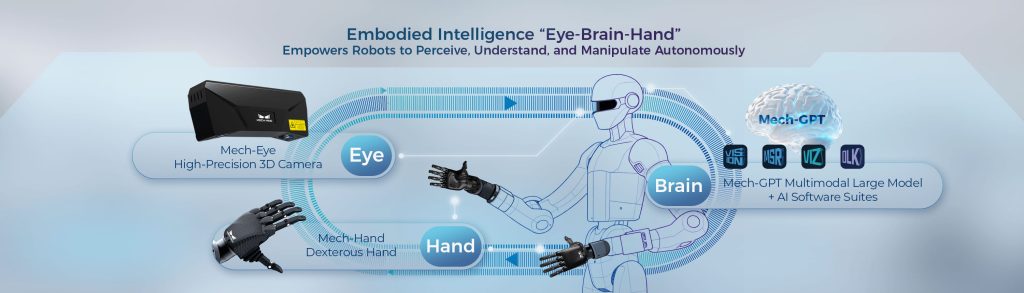
The architecture of the Mech-Mind system mirrors human cognitive-motor functions by seamlessly integrating “Eye, Brain, and Hand.” This shifts industrial robots from hardcoded positional execution to dynamic, real-time decision-making and environmental adaptation.
- EYE (Perception): The Mech-Eye Industrial 3D Camera scans the working area in real time, capturing rich 3D spatial data.
- BRAIN (Planning & Intelligence): Processes spatial data via a tripartite software suite:
- Mech-Vision: Handles vision processing, inspection, and localization.
- Mech-DLK: Deploys deep learning algorithms for complex object recognition.
- Mech-Viz: Manages 3D simulation and collision-free path planning.
- HAND (Execution): The industrial robot executes the calculated trajectory to perform physical tasks, including Pick, Place, Load, Unload, Assemble, or Palletize.
The synchronized interaction of these three pillars empowers robots to operate with high intelligence and agility, ready to adapt to instant changes on the shop floor.
Transforming Production Lines with Unmatched Flexibility
From an enterprise perspective, the true value of AI + 3D Vision extends far beyond replacing manual labor—it introduces radical operational flexibility, enabling automated systems to handle high product variability and complex part layouts with ease.
Vision-Guided Robotics redefines the manufacturing landscape by mastering tasks that traditional fixed automation struggled to accomplish, such as:
- Random Bin Picking: Extracting chaotic, unstructured parts from deep bins.
- Machine Tending: Automating part loading and unloading for CNCs and processing machines.
- Assembly: Joining complex components requiring ultra-high spatial precision.
- Palletizing & Depalletizing: Stacking and destacking mixed goods on pallets.
By unlocking these capabilities, manufacturers can expand automation across broader operational domains—boosting overall productivity, relieving workers from repetitive tasks, and establishing consistent, sustainable quality standards for modern smart factories.